
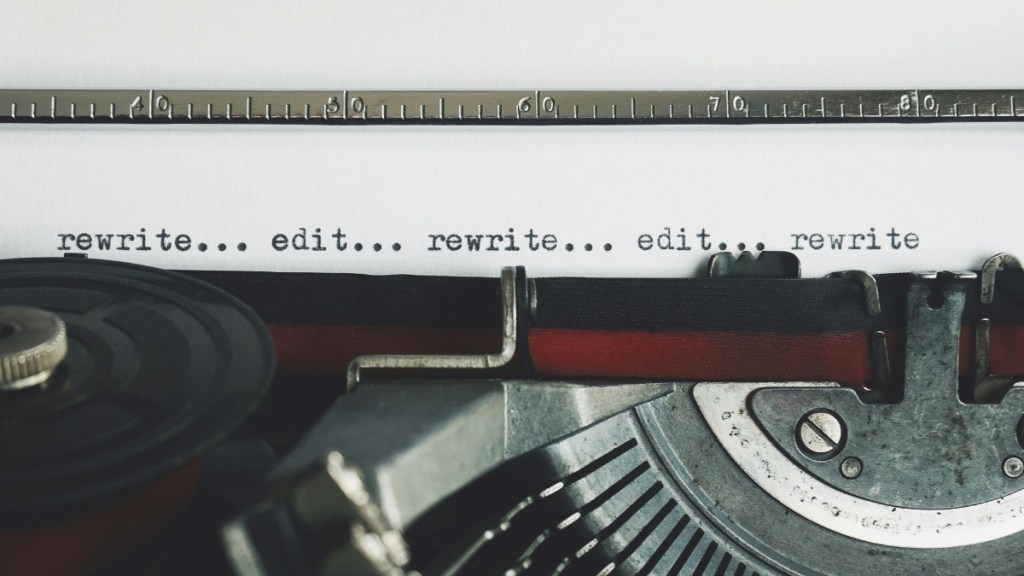
After developmental and line editing, it’s time to polish formatting, grammar, spelling, and punctuation.
Most word processors will have some sort of AI that will catch many grammar and punctuation errors. Additionally, you can use programs like Grammarly. But much of this will be the responsibility of the eyes of humans. Specifically, yours!:)
Please note this document doesn’t cover all copy editing faux pas. It serves as a general guide to help you make your manuscript less muddled.
Formatting
Industry standard formatting of a manuscript is a fundamental step many authors overlook. Non-standard formatting can impact readability. You don’t know if the agent/editor is reading your manuscript in Word, Google Docs, on their Kindle, or another medium. Formatting matters.
For your story to shine, you want the visual appearance not to stand in the way. Below is a guide on manuscript formatting. It will show agents you’ve done the research and taken the time to implement it.
Title Page
Contact Info
Upper left-hand corner, left justified, single-spaced. It should include your legal name, mailing address, phone number, and email.
Title
Three-quarters of the way the page center-justified.
Author Name
One double space below title. If you are writing under a pen name that’s the name you put here.
Word Count
One double space below author name. Rounded to the nearest thousand.
Manuscript
- 8.5 x 11 inch page
- One inch margin on each side
- Double spaced
- Single spaces after periods
- Use a # to signify scene breaks
- Left justified alignment
- 12-point font
- Times New Roman—Black
- Type THE END at the end so readers know they received the full manuscript
Headers
Set up a header (excluding the title page) that includes your last name, book title, and page number.
Paragraphs
To indent don’t use spaces or tabs—set up automatic paragraph indentation. Search your word processor’s help function to find out how to do this.
Chapters
Use Page Break feature at the end of each chapter so each chapter automatically starts on a new page.
Chapter Titles or Numbers
Center-align and justify. Start the chapter ½ to 1/3 of the way down and use consistently at the start of each chapter. Start the chapter one double space down from the chapter title.
Stylistic Choices
This isn’t the time to use non-industry standard stylistic choices. Avoid fancy fonts and inconsistent font sizes. Do not overuse italics and bold. You want your manuscript to be as easy to read as possible. The creative stylistic choices will happen later. This occurs when your book is sold to a publisher, edited, and enters the layout phase of the publishing process.
Check Point
Check out this video by Shaeline Writes of Reedsy for an easy to follow formatting tutorial.
If Word is your word processor of choice, good news! They offer a manuscript template! In Word select File New From Template and type in Story Manuscript. Simply follow the directions and you’ll be off to a great start!
Grammar
Modifiers
Modifiers are words or phrases that modify their sentence’s meaning by adding details. When using modifiers, you want to place them close to the part of the sentence they are modifying. I’m going to simplify this. It can be very confusing. There are different types of modifiers and different modifier mistakes.
Example:
Dangling Modifiers
In a dangling modifier, the subject of the modifier is missing or unclear.
Incorrect: Celebrating her thirtieth birthday, I hosted Dirty Thirty party for my sister.
Correct: I hosted a Dirty Thirty party for my sister’s thirtieth birthday.
The incorrect version uses a dangling modifier. The revision gets rid of both the -ing verb and the dangling modifier.
Incorrect: Bolting out the door, a shoe flew off her foot. (A shoe isn’t bolting out the door.)
Correct: As she bolted out the door, her shoe flew off.
Better: Her shoe flew off as she bolted out the door. (no modifier needed.)
Run-On Sentences
Run-on sentences are one of the most common grammar mistakes by emerging authors. It’s when two independent clauses (both have subjects and verbs) are joined together by improper punctuation. And it’s an easy fix! If a long sentence can easily be broken down into two smaller sentences—do it!
Incorrect: Red velvet cake is my favorite, I eat it often.
Correct: Red velvet cake is my favorite. I eat it often.
Subject-Verb Agreement
A disagreement in subject-verb occurs when the subject and verb in a sentence do not match in number. A singular subject requires a singular verb. A plural subject requires a plural verb.
Incorrect: The group of students are excited for the field trip.
Correct: The group of students is excited for the field trip.
Group is singular therefore calls for a singular verb.
Hyphens VS Em Dashes
A hyphen is used to join two words together. An em dash is used to signal pause, emphasis, or provide additional information via a clause.
Hyphen: Our daughter turned thirty-three this year.
Em Dash: We celebrated our daughter’s thirtieth birthday this year—a milestone for us all.
An em dash is not a hyphen. Use the help function on your word processor to see how to create an em dash.
Who(m) VS That
Who(m) refers to people while that refers to inanimate objects.
Incorrect: She was the one friend that I could count on.
Correct: She was the one friend whom I could count on.
Check Point:
Run your manuscript through Grammarly to see if you can catch your grammar faux pas tendacies.
Spelling
Always run your manuscript through spell check software. Most word processors do have this function, but don’t automatically accept all corrections. You want to double-check yourself as well.
If you have words in your manuscript you’ve made up, add them to your word processor’s dictionary. Add words with unique spelling, too. This includes unique places or names. Adding them ensures those words can be checked as well.
Check Point:
I know I used it earlier, but Grammarly is also a great tool for checking spelling errors.
Commonly Misused Words
Search for these and check to ensure you are using them correctly.
• affect/effect
• alright/all right
• altogether/all together
• altar/alter
• among/between
• amount/number
• bad/ill, good/well
• blond/blonde
• brunet/brunette
• board/bored
• complement/compliment
• council/counsel
• discussed/disgust
• each/every
• fewer/less
• fiancé/fiancée
• here/hear
• idol/idle
• lesson/lessen
• lie/lay
• lightning/lightening
• loose/lose
• mantle/mantel
• message/massage
• parent’s/parents’
• passed/past
• peel/peal
• pique/peak/peel
• principal/principle
• reign/rein
• stationary/stationery
• that/which
• there/their/they’re
• then/than
• to/two/too
• who/whom
• who’s/whose
• your/you’re
Check Point:
Punctuation
Apostrophes
Singular Nouns
Place the apostrophe before the s. Ex. The girl’s doll
Plural Nouns
Place the apostrophe after the s. Ex. The girls’ dolls
Nouns ending in s or ss
Either place an apostrophe after the s or add an apostrophe s. Either way is correct but use it consistently. The only exception is for the possessive of it—use its. It’s is for the contract of “it is.”
Contractions
Use an apostrophe in place of the missing letter.
Incorrect: Your’e welcome.
Correct: You’re welcome.
Commas
Use a comma between two independent clauses.
Correct: Amy opened the fridge, and she grabbed a snack. (But really this could be written using a dependent clause and you can remove the comma.
Better: Amy opened the fridge and grabbed a snack.
Oxford Comma
Use a comma when naming items in a list including before the word and.
Incorrect: Amy opened the fridge and grabbed blueberries, strawberries and grapes.
Correct: Amy opened the fridge and grabbed blueberries, strawberries, and grapes.
In Dates
The birthday party is in Mayflower, Florida on May 20, 2025.
Splicing
This is when two independent clauses are joined by a comma.
Incorrect: Amy opened the fridge, she grabbed a snack.
A period should be used instead.
Correct: Amy opened the fridge. She grabbed a snack.
Dialogue
Correctly punctuated dialogue is a good sign of a polished manuscript.
Incorrect: “I’m exhausted,” Amy said, then stretched and yawned.
Dialogue Tags: Use a comma. “I’m exhausted,” Amy said.
Action Beat: Use a period. “I’m exhausted.” Amy stretched and yawned.
You do not need a dialogue tag when you have an action beat. A dialogue tag is only to show who is speaking if the reader may not know.
Additionally with dialogue, you don’t want another character’s actions in the same paragraph as another character’s dialogue.
Incorrect: “I’m exhausted.” Amy stretched and yawned. Tony tossed her a blanket.
Correct: “I’m exhausted.” Amy stretched and yawned.
Tony tossed her a blanket.
Check Point:
Text Messages
You will probably need to include a text or two if you’re writing contemporary fiction. You might use dozens if you write YA! Currently, there is no industry standard in formatting them in your on-sub manuscript. But here are some suggestions to consider.
Manuscript: Your unpublished manuscript is not a place to make stylistic decisions on formatting. That will happen after you get a pub deal in layout. Formatting at this stage is only to make your manuscript as readable as possible.
Readability: Typography such as bold and italics can impact readability.
Consistency: Whatever you chose, use it consistently. However, keeping the same font is preferred by most publishers at this stage.
For example:
He tapped his smartphone screen to life. His two-day no contact post date one—officially up. Time to check-in with the girl he’d hoped to see again.
Brandon: Hey. What’s up?
Three dots appear then disappear. Then reappear.
Heather: Hi! Been super busy with work. What’s up with you?
When In Doubt: Keep it simple:)
Closing
As stated earlier, this is not a comprehensive list of all things to consider in the copy-editing phase. And good news, You are NOT a copy-editor! You are an author!
Hopefully, this guide will help you improve so copy edits don’t stand in the way of an agent or editor enjoying your wonderful story!
For a Master Class in Copy Editing check out Benjamin Dryer (Random House Copy Editor of Thirty Years) and author of the Dryer’s English in the video below!
Shout-out to the typos that make it through self-editing, content editing, extensive copy editing, and even a final proofread. We are inspired by your dedication and tenacity. And we hate you. Just saying…”
-Every Editor & Author Everywhere


 Amy Nielsen
Leave a comment